
And How to Break Free
Many leaders believe their growth problem is external.
They think the barrier is:
- Lack of time
- Lack of credentials
- Lack of opportunity
- Lack of organizational support
- Lack of confidence
Sometimes those factors matter.
But often, the real limitation is internal.
A belief.
A quiet narrative repeated so many times it begins to feel like truth.
And the dangerous part?
Most leaders never question it.
The Leadership Barrier Most People Never Examine
Leadership development conversations often focus on strategy, productivity, communication frameworks, or technical competency.
Those matter.
But leadership behavior is frequently driven less by knowledge and more by identity.
What you believe about yourself influences:
- How you communicate
- How you handle conflict
- How you respond to pressure
- Whether you pursue opportunities
- How you recover from failure
- Whether you trust your own decision-making
That means many leadership limitations are not skill deficits.
They are belief systems operating underneath awareness.
The Hidden Scripts Leaders Carry
Many limiting beliefs sound normal because they become socially reinforced over time.
Examples include:
- “I’m not naturally a leader.”
- “I’ve always struggled with communication.”
- “I’m just not confident.”
- “I’m too emotional.”
- “I’m not strategic enough.”
- “People like me usually don’t advance.”
- “That’s just the way I am.”
The problem is not simply having these thoughts.
The problem is treating them as permanent identity statements instead of temporary interpretations.
Once a belief becomes identity-based, leaders stop experimenting, stretching, and adapting.
That is where stagnation begins.
Your Brain Protects Familiarity—Even When It Limits You
Research in cognitive psychology and mindset theory consistently shows that beliefs shape perception, behavior, and performance outcomes.
Studies associated with growth mindset research from Carol Dweck demonstrate that individuals who believe abilities can develop through effort and learning tend to show greater resilience, adaptability, and long-term achievement than those operating from fixed identity assumptions.
Your brain seeks efficiency.
It creates patterns and reinforces familiar interpretations to reduce uncertainty.
That means if a leader repeatedly tells themselves:
“I’m not good at difficult conversations.”
their brain begins filtering experiences through that assumption.
They avoid practice.
Avoidance reduces growth.
Reduced growth reinforces the belief.
The cycle repeats.
This is why leadership transformation requires more than motivation.
It requires awareness.
Limiting Beliefs Quietly Damage Leadership Capacity
Unchecked beliefs often produce outcomes leaders misdiagnose as burnout, lack of motivation, or organizational frustration.
In reality, internal narratives may be restricting growth long before external barriers appear.
Common consequences include:
Reduced Adaptability
Leaders resist feedback because feedback threatens identity.
Stagnant Growth
Leaders stop developing once they believe their weaknesses are fixed traits.
Missed Opportunities
Qualified leaders avoid promotions, visibility, or innovation because they already assume failure.
Emotional Reactivity
Internal insecurity often surfaces as defensiveness, perfectionism, avoidance, or control behaviors.
Lower Organizational Influence
Leaders operating from fear-based beliefs struggle to create trust, clarity, and psychological safety for others.
Why Traditional Leadership Development Often Falls Short
Many leadership programs teach external strategies without addressing internal belief systems.
That creates temporary improvement but limited transformation.
A leader can learn communication tactics while still believing:
- “My voice doesn’t matter.”
- “People won’t respect me.”
- “I always fail under pressure.”
Without addressing the underlying belief structure, behavior change rarely becomes sustainable.
That is why self-awareness is not optional in leadership development.
It is foundational.
The JOY Mindset® Approach to Reframing Beliefs
At JOY (Journey Options YouChoose), we view leadership growth through the lens of wholistic wellness:
- Spirit
- Mind
- Heart
- Body
The JOY Mindset® helps leaders identify the beliefs shaping their behaviors, reactions, communication patterns, and leadership decisions.
Transformation begins when leaders learn to examine beliefs instead of automatically obeying them.
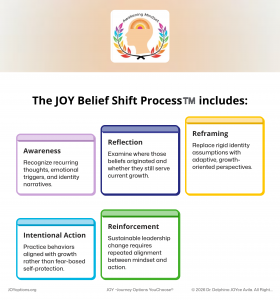
That process includes:
1. Awareness
Recognize recurring thoughts, emotional triggers, and identity narratives.
2. Reflection
Examine where those beliefs originated and whether they still serve current growth.
3. Reframing
Replace rigid identity assumptions with adaptive, growth-oriented perspectives.
4. Intentional Action
Practice behaviors aligned with growth rather than fear-based self-protection.
5. Reinforcement
Sustainable leadership change requires repeated alignment between mindset and action.
This is not motivational positivity.
It is cognitive and behavioral recalibration.
A Better Leadership Question
Many leaders ask:
“What skill do I need next?”
A more powerful question may be:
“What belief is limiting the way I lead right now?”
Because leadership growth accelerates when awareness expands.
And awareness expands when leaders stop treating outdated beliefs as permanent truth.
Reflection Question
What belief about yourself might be outdated—but still guiding your leadership?
Ready to Assess Your Leadership Mindset?
The JOY Mindset® Assessment helps leaders evaluate behavioral patterns, self-leadership tendencies, and mindset alignment connected to growth, resilience, and wholistic wellness.
Take the assessment here:
Additional Resources
Watch the companion video:
YouTube Video – The Hidden Beliefs That Keep Leaders Stuck
Purchase Awaken JOY:
#drdelphinajoy #LEADwithJOY #SHINEwithJOY #MessengerofJOY
Research References
1. Growth Mindset and Leadership Research
Research connected to Carol Dweck demonstrates that leaders who operate from a growth mindset tend to show higher adaptability, learning orientation, and resilience in leadership environments.
Harvard Business Review – How Microsoft Uses a Growth Mindset to Develop Leaders
2. Organizational Mindset and Workplace Culture
Research published in Personality and Social Psychology Bulletin found that organizational mindset significantly predicts employee trust, commitment, and perceptions of workplace culture.
Cultures of Genius at Work: Organizational Mindsets Predict Cultural Norms, Trust, and Commitment
3. Growth Mindset and Leadership Development
Leadership research continues to show that leaders who believe capabilities can develop through learning and effort create stronger developmental cultures and improved engagement outcomes.