
(And Why Triggers Are the Missing Variable)
Most leadership development conversations focus on reflection.
Very few address triggers.
That is a problem.
Because you do not lose self-awareness in calm moments.
You lose it in triggered moments.
So the real question is not simply:
“How self-aware are you?”
It is:
“What happens to your awareness when you are emotionally activated?”
That is where leadership quality is either revealed or compromised.
What Are Triggers (In Leadership Terms)?
A trigger is any internal or external stimulus that activates a strong emotional, cognitive, or physiological response that is disproportionate to the present moment (Gross, 1998).
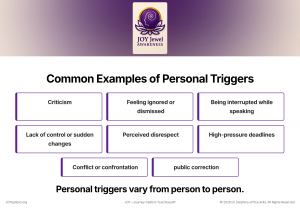
In leadership contexts, triggers often show up as:
- A tone of voice that feels disrespectful
- A perceived lack of competence from others
- Being questioned in meetings
- Feeling excluded from decisions
- Receiving critical feedback
- Loss of control or uncertainty
- Time pressure or competing demands
A trigger is not the event itself.
It is the meaning your nervous system assigns to the event based on past experience, identity, and belief structures (LeDoux, 1996; Kegan & Lahey, 2009).
Which means:
Two leaders can experience the same situation
and produce completely different reactions.
Why Triggers Disrupt Self-Awareness
Self-awareness depends on access to your observing mind—the part of you that can notice thoughts, emotions, and behavior without immediately reacting (Siegel, 2010).
Triggers disrupt that access.
When a trigger activates:
1. Cognitive narrowing occurs
Your thinking becomes more rigid and reactive (Kahneman, 2011).
2. Emotional override increases
Emotion begins to drive interpretation and decision-making (Goleman, 1995).
3. Identity protection activates
You shift from “What is true?” to “How do I protect myself?” (Kegan & Lahey, 2009).
4. Behavior becomes automatic
You respond from pattern, not choice (Baumeister et al., 2007).
In that state, self-awareness is reduced—not because you lack intelligence, but because your regulatory capacity is temporarily hijacked.
The Leadership Blind Spot
Many leaders believe:
“I’m self-aware because I reflect.”
But reflection after the fact is not the full picture.
If you only examine your behavior after you are triggered, you are doing post-event analysis, not real-time awareness development.
The critical gap is this:
Can you notice yourself while you are being triggered?
Most cannot—because they were never trained to recognize the early signals.
How Triggers Affect Leadership Behavior
Unprocessed triggers tend to produce predictable leadership distortions:
- Over-controlling behavior when feeling uncertain
- Silence or withdrawal when feeling undervalued
- Over-explaining when feeling questioned
- Defensive communication when feeling exposed
- Impulsive decisions when feeling pressured
- Emotional escalation when feeling ignored
None of these are random.
They are patterned protective responses rooted in threat-response systems (Rock, 2008).
Which is why experience alone does not guarantee leadership maturity.
Without awareness of triggers, leaders simply become more sophisticated at repeating the same reactions.
The Real Role of Self-Awareness
Self-awareness is not just “knowing yourself.”
In leadership performance terms, self-awareness is:
The ability to recognize internal activation (triggers) in real time and choose a response rather than defaulting to pattern.
That requires three capacities:
1. Recognition
Noticing emotional and physiological shifts early.
2. Naming
Identifying what is happening without justification or denial.
3. Regulation
Creating space between stimulus and response.
Without all three, awareness collapses under pressure.
Why Most Leaders Never Develop This Skill
Many environments reward speed, decisiveness, and output.
Very few reward internal observation.
So leaders learn to:
- Push through discomfort
- Ignore emotional signals
- Prioritize urgency over awareness
- Equate reflection with delay
Over time, they become highly functional externally but increasingly reactive internally.
That is not leadership clarity.
That is leadership automation.
How Structured Awareness Rebuilds Control
This is where intentional practice matters.
Self-awareness strengthens when leaders intentionally integrate:
- Speaking: naming what is happening internally
- Listening: noticing reactions without interruption
- Reading: exposing thinking patterns to new frameworks
- Writing: externalizing thoughts to slow cognitive reactivity
The JOY Mindset® approach uses these as structured cognitive practices, not passive habits.
They function as neural integration tools—helping leaders reconnect thinking, emotion, and behavior before reaction becomes default.
Over time, this builds:
- Faster trigger recognition
- Reduced emotional reactivity
- Increased cognitive flexibility
- More intentional leadership decisions
- Stronger adaptability under pressure
The Core Shift
Self-awareness is not the absence of triggers.
It is the ability to remain present while they are active.
That is the difference between:
- Reacting vs responding
- Defending vs learning
- Controlling vs leading
- Surviving patterns vs evolving behavior
Final Question
What patterns are currently running your leadership when you are triggered—and have you actually observed them in real time, or only recognized them after the fact?
Because what you do after reflection matters.
But what you do during activation defines your leadership.
Take Action -ACTIVATE JOY
💡 Take the JOY Mindset® Assessment to evaluate how consistently you are operating from awareness versus reactivity:
https://joyoptions.org/joy-mindset-assessment/
#drdelphinajoy #LEADwithJOY #SHINEwithJOY #MessengerofJOY
Whether you’re a leader, coach, educator, or professional — your journey to greater impact starts from the inside out. The world needs leaders who know themselves. Start today.
#drdelphinajoy #LEADwithJOY #SHINEwithJOY #MessengerofJOY
References
Gross, J. J. (1998). The emerging field of emotion regulation: An integrative review.
https://psycnet.apa.org/record/1998-04389-001
LeDoux, J. (1996/1998). The Emotional Brain: The Mysterious Underpinnings of Emotional Life.
https://www.simonandschuster.com/books/The-Emotional-Brain/Joseph-Ledoux/9780684836591
Goleman, D. (1995). Emotional Intelligence.
https://www.danielgoleman.info/topics/emotional-intelligence/
Kahneman, D. (2011). Thinking, Fast and Slow.
https://us.macmillan.com/books/9780374533557/thinkingfastandslow
Baumeister, R. F., Vohs, K. D., & Tice, D. M. (2007). The strength model of self-control.
https://doi.org/10.1111/j.1467-8721.2007.00534.x
Siegel, D. J. (2010). Mindsight.
https://drdansiegel.com/book/mindsight/
Kegan, R., & Lahey, L. L. (2009). Immunity to Change.
https://mindsatwork.com/immunity-to-change/
Fredrickson, B. L. (2001). The role of positive emotions in positive psychology.
https://doi.org/10.1037/0003-066X.56.3.218
Rock, D. (2008). SCARF: A brain-based model for collaborating with and influencing others.
Direct PDF:
https://medschool.cuanschutz.edu/docs/librariesprovider31/patient-care/ihqse/diagnostic-excellence-program/rock-2008-scarf-brain-based-model-for-collaborating-and-influencing.pdf