

Most leadership conversations focus on visible performance:
-
Communication skills
-
Strategic execution
-
Productivity
-
Decision-making
-
Team management
-
Influence
Those matter.
But leadership growth is often determined long before performance becomes visible.
It begins in the mind.
Not in motivational slogans.
Not in surface-level positivity.
In the internal thought patterns leaders repeatedly reinforce every day.
Because leadership behavior is rarely disconnected from leadership mindset.
The Leadership Variable Organizations Commonly Overlook
Many organizations evaluate outcomes while ignoring the thinking patterns producing those outcomes.
A leader may appear hesitant, resistant to feedback, disengaged, overly controlling, or risk-avoidant.
The assumption is often:
-
Lack of skill
-
Lack of training
-
Lack of motivation
But deeper coaching conversations frequently reveal something else: A mindset operating beneath awareness.
Thoughts such as:
-
“I’m not ready yet.”
-
“That’s outside my expertise.”
-
“I’m not experienced enough.”
-
“What if I fail publicly?”
-
“Other people are naturally better leaders.”
These thoughts shape leadership behavior far more than most professionals realize.
Because the mind influences:
-
Risk tolerance
-
Emotional regulation
-
Confidence
-
Adaptability
-
Decision-making
-
Innovation
-
Communication patterns
-
Resilience under pressure
The question is not whether mindset affects leadership.
The question is whether your mindset is strengthening your growth—or quietly restricting it.
The Difference Between a Growth Mindset and a Limiting Mindset
A growth-oriented mindset views development as possible through learning, effort, reflection, and adaptation.
A limiting mindset interprets abilities as fixed, permanent, or identity-based.
The difference becomes visible in leadership behavior.
| Growth-Oriented Leadership | Limiting Leadership |
|---|---|
| Seeks feedback | Avoids feedback |
| Learns through discomfort | Avoids discomfort |
| Views mistakes as information | Views mistakes as identity failure |
| Experiments and adapts | Protects familiarity |
| Pursues growth opportunities | Waits until feeling “fully ready” |
| Develops resilience | Reinforces fear-based avoidance |
Leaders with growth-oriented thinking are not fearless.
They simply do not allow discomfort to permanently define their identity.
Why Mindset Often Predicts Leadership Trajectory
Coaching conversations consistently reveal a pattern:
Mindset shifts frequently happen before visible leadership breakthroughs.
Before leaders improve communication, increase influence, or expand organizational impact, they often first change how they think about themselves.
That shift matters because the brain reinforces repeated beliefs.
If a leader repeatedly thinks:
“I’m not capable of leading at that level.”
their behaviors begin aligning with that assumption.
They hesitate.
Avoid visibility.
Decline opportunities.
Overprepare.
Delay action.
Remain silent in key moments.
Eventually, the belief appears “confirmed.”
Not because it was true.
Because it shaped behavior.
The Neuroscience Behind Leadership Mindset
Research in cognitive psychology and neuroscience demonstrates that repeated thought patterns influence behavior, learning, and adaptability.
Studies on neuroplasticity show the brain continually reorganizes itself through repeated experiences, behaviors, and cognitive patterns. Leaders who intentionally challenge limiting beliefs and practice adaptive thinking strengthen new neural pathways connected to learning and resilience.
This is one reason mindset development matters in leadership.
Repeated thinking becomes repeated behavior.
Repeated behavior becomes leadership identity.
Many Professionals Mistake Credentials for Growth
A common leadership misconception is this: “Once I have more experience, then I’ll feel confident.”
But confidence rarely appears first.
Action often precedes confidence.
Many highly credentialed professionals still operate from limiting beliefs:
-
Fear of criticism
-
Fear of visibility
-
Fear of uncertainty
-
Fear of inadequacy
-
Fear of failure
Additional credentials do not automatically remove limiting beliefs.
Sometimes they simply create more sophisticated avoidance patterns.
Real growth requires examining the internal narratives driving behavior.
Signs Your Mindset May Be Limiting Your Leadership
Some mindset limitations are subtle.
They may appear as: Constant Self-Disqualification
You repeatedly talk yourself out of opportunities before others even evaluate you.
Perfectionism
You delay action until conditions feel “safe enough.”
Resistance to Feedback
Feedback feels threatening instead of developmental.
Overidentification with Weaknesses
You describe challenges as permanent personality traits.
Fixed Leadership Identity
You believe leadership ability is something people either naturally possess or permanently lack.
Avoidance of Stretch Opportunities
You remain in familiar environments because growth feels uncomfortable.
These patterns often reduce leadership adaptability, innovation, and long-term influence.
The JOY Mindset® Perspective
At JOY (Journey Options YouChoose), leadership development is approached through wholistic wellness:
-
Spirit
-
Mind
-
Heart
-
Body
The JOY Mindset® emphasizes intentional awareness because sustainable leadership growth requires leaders to examine both behavior and belief systems.
Awareness creates choice.
Without awareness, leaders often operate from unconscious patterns shaped by fear, past experiences, insecurity, or outdated self-perceptions.
The goal is not toxic positivity.
The goal is intentional alignment between mindset, behavior, and growth.
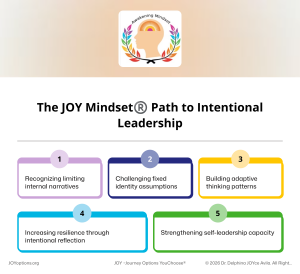
That includes:
-
Recognizing limiting internal narratives
-
Challenging fixed identity assumptions
-
Building adaptive thinking patterns
-
Increasing resilience through intentional reflection
-
Strengthening self-leadership capacity
Leadership transformation is not simply external performance improvement.
It is internal recalibration.
A More Important Leadership Question
Many professionals ask:
“How do I become more successful?”
A deeper question may be:
“What thinking patterns are shaping the way I lead right now?”
Because leadership growth is not only determined by what you know.
It is also determined by what you repeatedly believe.
Reflection Question
Is your current mindset expanding your leadership—or quietly limiting it?
Ready to Evaluate Your Leadership Mindset?
The JOY Mindset® Assessment helps leaders examine behavioral patterns, resilience, self-leadership, and growth-oriented thinking connected to long-term leadership development.
Take the assessment here:
JOY Mindset® Assessment
Additional Resources
Watch the companion video:
Awareness: The Leadership Skill Most Professionals Overestimate
Purchase the Awakening Mindset™ Downloadable Tool:
Awaken the Awakening Mindset™
Research References
1. Growth Mindset and Leadership Development
Research associated with Carol Dweck demonstrates that growth-oriented thinking improves resilience, learning behavior, and adaptability in professional environments.
Harvard Business Review – Growth Mindset and Leadership Development
2. Neuroplasticity and Behavioral Change
Research from the National Institutes of Health highlights how repeated cognitive and behavioral patterns reshape neural pathways, supporting learning and adaptive growth.
NIH – Neuroplasticity Research Overview
3. Mindset, Resilience, and Performance
Research published through the American Psychological Association connects adaptive thinking patterns with resilience, performance improvement, and stress management.
American Psychological Association – Building Resilience
#drdelphinajoy #LEADwithJOY #SHINEwithJOY #MessengerofJOY