

Are your beliefs quietly limiting the life you’re capable of living?
Many professionals assume the biggest barriers to growth are lack of resources, opportunities, or strategy.
But the real barrier is often invisible.
It’s the quiet voice that says:
- “I’m not ready yet.”
- “People like me don’t succeed at that level.”
- “Maybe later… when I’m more prepared.”
These are limiting beliefs—internal narratives that shape decisions long before action even begins.
If you don’t challenge them, they quietly shape your leadership, your confidence, and ultimately your impact.
The JOY Mindset® Shift
Stop treating beliefs as fixed truths.
They are learned assumptions, and you have the power to choose differently.
This is the core of Sustainable JOY™ and self-leadership:
What you believe influences what you do.
When leaders change what they believe is possible, they change what they actually pursue.
Research in cognitive psychology confirms that beliefs function as mental filters shaping perception, decision-making, and motivation (Beck, 2011; Dweck, 2016).
When leaders examine those beliefs, they reclaim agency over their actions.
That is the essence of the JOY Mindset®.
Core Insight
What It Is – What-Is-a-Limiting-Belief
Limiting beliefs are internal assumptions about what we are capable of achieving.
They often originate from past experiences, social conditioning, or early feedback that becomes internalized over time.
Psychological research shows that individuals form cognitive schemas—mental frameworks that influence how they interpret events and opportunities (Beck, 2011).
When those schemas become restrictive, they narrow perception and reduce risk-taking.
Why It Matters
Limiting beliefs affect leadership more than most professionals realize.
Research indicates that belief systems influence:
- Risk tolerance and innovation (Bandura, 1997)
- Leadership confidence and initiative (Dweck, 2016)
- Persistence when facing setbacks (Duckworth, 2016)
Leaders who operate from restrictive belief systems often avoid opportunities, hesitate to lead, or underestimate their influence.
The challenge is rarely ability. The challenge is perception.
Leadership Impact
Imagine two leaders facing the same opportunity to present a bold idea.
Leader one believes:
“I may not know everything, but I can figure it out.”
Leader two believes:
“I’m probably not qualified enough.”
The first leader engages, experiments, and moves forward.
The second hesitates, delays, or withdraws.
The difference is not intelligence, experience, or title.
The difference is belief.
Research on self-efficacy consistently shows that individuals who believe they can influence outcomes are significantly more likely to take action (Bandura, 1997).
JOY Mindset® Tool
A Practical Framework to Shift Limiting Beliefs
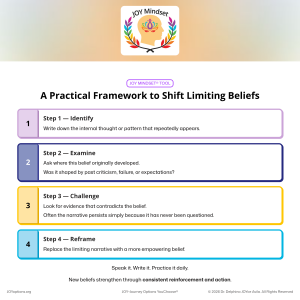 Step 1 — Identify
Write down the internal thought or pattern that repeatedly appears.
Step 2 — Examine
Ask where this belief originally developed.
Was it shaped by past criticism, failure, or expectations?
Step 3 — Challenge
Look for evidence that contradicts the belief.
Often the narrative persists simply because it has never been questioned.
Step 4 — Reframe
Replace the limiting narrative with a more empowering belief.
Example:
Old narrative:
“I’m not experienced enough to lead.”
New narrative:
“My experience will grow through leadership.”
Speak it. Write it. Practice it daily.
New beliefs strengthen through consistent reinforcement and action.
Real Leadership Example
Meet Maya. At 34, Maya had always dreamed of starting her own business. But every time she got close, a familiar voice would whisper: “You’re not experienced enough. Who would buy from you? What if you fail?”
These weren’t facts — they were beliefs formed from a critical parent and a failed school project at age 12. For 10 years, Maya stayed stuck.
It was belief influencing behavior.
Then, used the JOY Mindset® Tool: A Practical Framework to Shift Limiting Beliefs.
- She named her belief.
- Traced its root,
- Challenged the belief
- Reframed it.
Six months later, she launched her business.
Maya’s story isn’t unique. It’s yours too — waiting to be rewritten.
Reflection Questions
Pause and consider these questions:
- What belief most influences my decisions right now?
- What evidence contradicts that belief?
- What would I pursue if that belief no longer controlled my thinking?
Self-leadership begins with honest reflection.
Sustainable JOY™ Brain Science Connection
Sustainable JOY™ integrates four cognitive actions that support leadership growth.
These practices strengthen neural pathways involved in awareness and decision-making.
Speaking → Neural Integration
Naming thoughts aloud activates cognitive processing that reshapes mental patterns.
Listening → Awareness
Listening to internal dialogue helps identify beliefs influencing behavior.
Reading → Learning
Exposure to new ideas expands mental frameworks.
Writing → Intentional Decision-Making
Writing consolidates insight into deliberate action.
Together these practices support:
- self-leadership
- resilience
- intentional growth
Neuroscience research shows that reflective writing and verbal processing help reorganize neural pathways associated with emotional regulation and decision-making (Lieberman, 2007; Pennebaker, 2018).
Closing Insight
Beliefs are not destiny.
They are patterns reinforced through repetition.
When leaders choose beliefs aligned with courage, curiosity, and capability, they unlock new possibilities for themselves and those they lead.
Sustainable JOY™ begins in the mind — and expands through intentional action.
THE INVITATION — Activate JOY
Are you ready to discover what beliefs are shaping your leadership?
The JOY Mindset® Assessment helps identify patterns influencing your growth, decisions, and resilience.
👉 Take the JOY Mindset® Assessment
https://joyoptions.org/joy-mindset-assessment/
Because awareness is the first step toward choosing JOY.
JOY is your free will.
And leadership begins the moment you choose it.
JOYoptions.org
References
Bandura, A. (1997). Self-Efficacy: The Exercise of Control. W.H. Freeman.
Beck, J. (2011). Cognitive Behavior Therapy: Basics and Beyond. Guilford Press.
Duckworth, A. (2016). Grit: The Power of Passion and Perseverance. Scribner.
Dweck, C. (2016). Mindset: The New Psychology of Success. Random House.
Lieberman, M. (2007). Social cognitive neuroscience: A review of core processes. Annual Review of Psychology.
Pennebaker, J. (2018). Expressive Writing in Psychological Science. Cambridge University Press.
JOYoptions.org
#drdelphinajoy #LEADwithJOY #SHINEwithJOY #MessengerofJOY #JOYMindset®