

Avoidance is one of the most expensive habits leaders carry.
I have worked with leaders across education systems, organizations, and community initiatives, and the same pattern appears again and again: difficult conversations delayed, decisions postponed, and growth avoided.
Not because leaders lack intelligence.
Not because they lack capability.
But because avoidance feels safer in the moment.
Yet leadership avoidance is never neutral. It slowly erodes trust, clarity, and momentum. Over time, what begins as a small delay becomes a culture of hesitation.
Great leadership requires something different.
It requires agency.
What Is Leadership Avoidance?
Leadership avoidance occurs when leaders postpone necessary actions that create discomfort. This can include:
-
Avoiding difficult conversations
-
Delaying strategic decisions
-
Ignoring accountability issues
-
Hesitating to address team conflict
-
Postponing needed change
At first, avoidance feels harmless. However, it creates ripple effects that weaken leadership influence.
When leaders hesitate, teams notice.
And uncertainty spreads quickly.
Why Leaders Fall Into the Avoidance Trap
Leadership avoidance rarely stems from incompetence. Instead, it often comes from very human reactions.
Common reasons leaders avoid action include:
-
Fear of conflict
Many leaders worry that addressing issues will create tension or damage relationships. -
Desire to be liked
Leaders sometimes prioritize approval over effectiveness. -
Decision fatigue
When leaders face constant pressure, postponing a decision can feel like relief. -
Perfectionism
Some leaders wait for the “perfect moment” that never arrives. -
Lack of self-awareness
Without reflection, avoidance patterns become invisible habits.
Because of this, leadership avoidance often goes unnoticed until the consequences appear.
The Real Cost of Leadership Avoidance
Avoidance does not eliminate problems.
It multiplies them.
When leaders delay action, several things happen simultaneously:
1. Trust Begins to Erode
Teams expect clarity and direction. When leaders avoid decisions, uncertainty increases.
People begin to question leadership confidence.
2. Problems Grow Larger
Issues rarely resolve themselves. What could have been a simple conversation often becomes a complex conflict later.
3. Organizational Momentum Slows
Progress requires decisive leadership. Avoidance creates hesitation that spreads across teams.
4. Leadership Credibility Weakens
Leaders build credibility through action. Avoidance signals uncertainty, even when leaders have strong intentions.
Over time, leadership avoidance becomes a silent barrier to growth.
The Shift From Avoidance to Agency
The most powerful leaders are not those who avoid discomfort.
They are the ones who step directly into it with intention.
This shift requires a mindset transformation—from avoidance to agency.
Agency means choosing responsibility over excuses.
Instead of asking,
“Why is this difficult?”
Leaders begin asking,
“What responsibility is mine to lead here?”
That small shift changes everything.
Four Ways to Break Leadership Avoidance
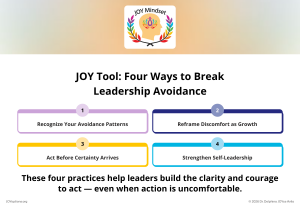
Breaking leadership avoidance requires intentional self-leadership. The following practices help leaders build clarity and courage.
1. Recognize Your Avoidance Patterns
Awareness is the first step toward change.
Ask yourself:
-
What conversations am I postponing?
-
What decisions am I delaying?
-
What challenges am I hoping will disappear?
Honest reflection reveals patterns quickly.
2. Reframe Discomfort as Growth
Discomfort is not a signal to retreat. It is often a signal that leadership is required.
When leaders shift their perspective, discomfort becomes a doorway to progress.
3. Act Before Certainty Arrives
Many leaders wait for perfect clarity.
However, strong leadership often requires decisive action with incomplete information.
Small steps forward build momentum.
4. Strengthen Self-Leadership
Leadership always begins within.
Organizations like Journey Options YouChoose emphasize that self-leadership is the foundation of effective leadership.
When leaders develop internal clarity, external leadership becomes far more powerful.
What Happens When Leaders Stop Avoiding
When leaders replace avoidance with agency, several powerful shifts occur:
- Conversations become more honest
- Decisions become clearer
- Teams gain confidence
- Momentum accelerates
- Leadership influence expands
Most importantly, leaders begin operating from purpose rather than fear.
This is where transformational leadership begins.
Reflect on Your Leadership Patterns
Every leader carries patterns.
Some strengthen leadership.
Others quietly limit it.
Recognizing leadership avoidance is not a failure—it is a turning point.
Because the moment awareness appears, change becomes possible.
Your next level of leadership clarity may begin with one honest question:
Where might avoidance be holding your leadership back?
THE INVITATION: Begin with Awareness
Ready to reflect on your leadership mindset and patterns?
👉 Start your JOY awareness journey here:
https://docs.google.com/forms/d/1y_Lp9qvaqyF7okQuZ8GPmYZOXpvVoPS1nSTcJeeFwTk/viewform
This reflection tool will help you examine how your leadership decisions, habits, and mindset shape your impact.
JOY is your free will.
And leadership begins the moment you choose it.
JOYoptions.org
#drdelphinajoy #LEADwithJOY #SHINEwithJOY #MessengerofJOY #JOYMindset®